Cop City and the Cameras: How Atlanta Traded Black Neighborhoods' Trees for an AI Surveillance Experiment
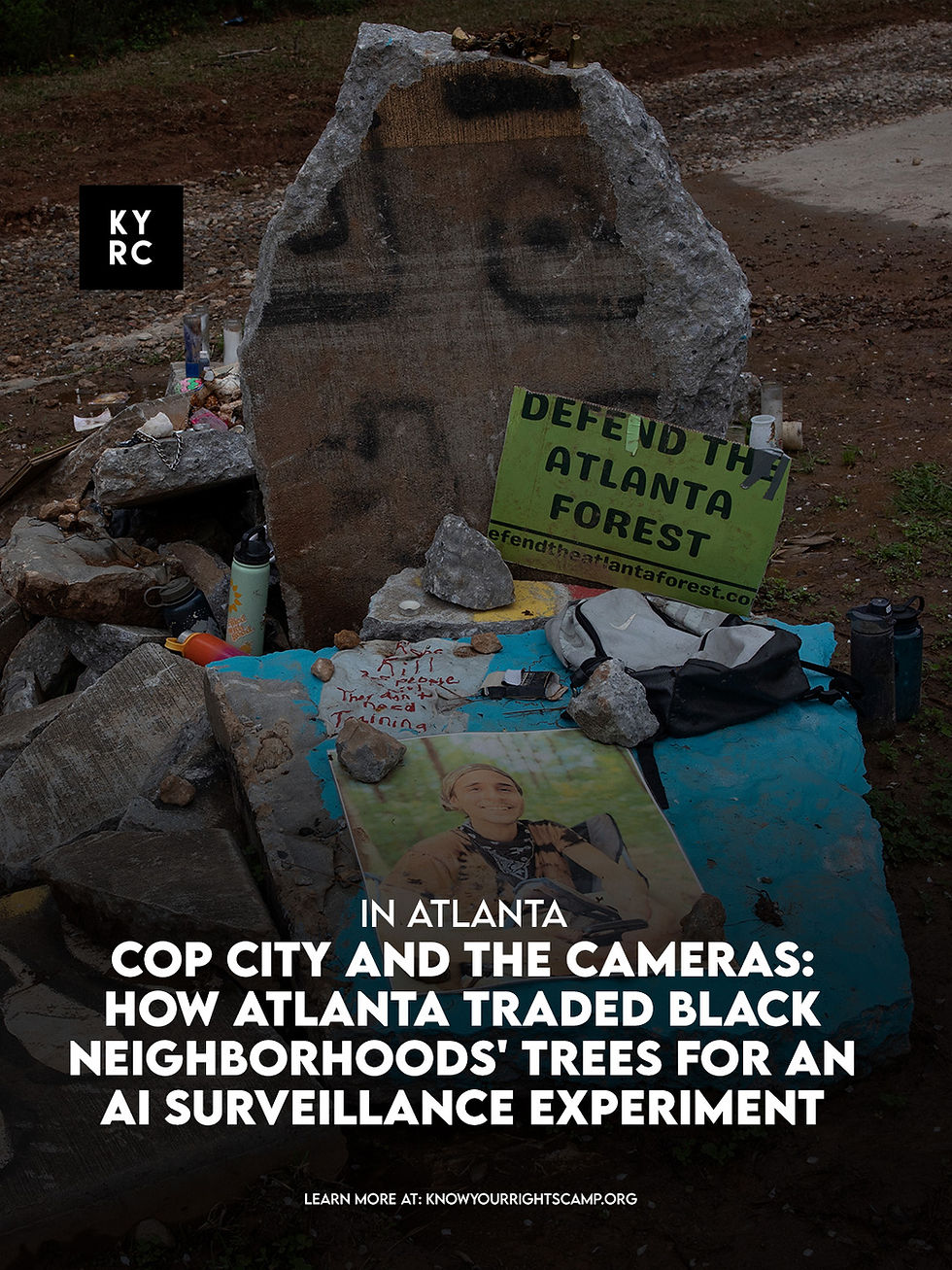
The expansion of Atlanta's surveillance state, anchored by the Atlanta Public Safety Training Center known as "Cop City," poses serious threats to Black and Brown communities who are already disproportionately surveilled, policed, and environmentally burdened. For residents like Brian Page, a 41-year-old raising his daughter in a majority-Black DeKalb County neighborhood, the network "certainly feels like an invasion of privacy." With more than 60,000 cameras linked to law enforcement, Atlanta now hosts roughly 124 surveillance cameras per 1,000 residents, denser than nearly any city on Earth outside China, and the cameras are most concentrated in predominantly Black west and south side neighborhoods.
This racialized targeting is amplified by AI. ACLU of Georgia's Shruti Lakshmanan warns, "Mass surveillance in general is the issue, but AI is almost supercharging what mass surveillance can do." Where surveillance once required suspicion, "AI allows police departments to ... generate suspicion." Facial recognition algorithms misidentify Black faces 10 to 100 times more often than white faces, with error rates for darker-skinned women as high as 35%, meaning Black residents face heightened risk of wrongful stops, arrests, and ICE entanglement, especially after reports revealed APD using Flock cameras to assist immigration enforcement.
The harm is also environmental. Cop City replaced 85 acres of urban forest that cooled and shielded Black neighborhoods already struggling with flooding, sewage failures, and extreme heat. Organizer Kamau Franklin connects the dots: "The surveillance system, the environmental issues, and the gentrification of Atlanta go hand in hand." Research confirms surveillance cameras cluster in gentrifying Black neighborhoods, and arrests rise as property values climb, a cycle that displaces Black residents while criminalizing those who remain.
Page fears most for young Black men who "always ironically fit the description of the suspect," and for his daughter, who will inherit this terrain. Lakshmanan cautions there is "kind of no end" to how the data can be misused against "protesters, immigrants, communities of color, LGBTQ people, people seeking reproductive care." For Black and Brown Atlantans, Cop City is not protection, it is a blueprint for deeper criminalization, displacement, and harm.
Link: Capital B News


Comments